
Blogs
Insightful discussions on building better culture
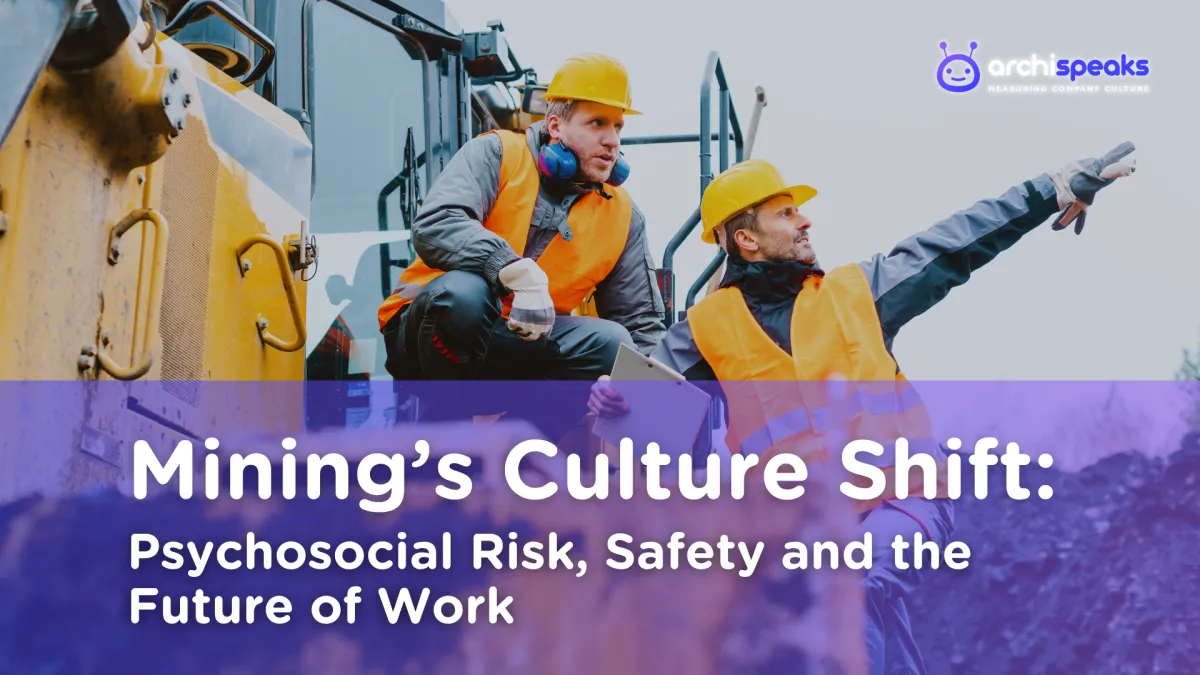
Mining’s Culture Shift: Psychosocial Risk, Safety and the Future of Work
In a world in constant flux, the mining industry is standing in the middle of its own transformation. The wake-up call delivered by the Enough is Enough report was not merely a denunciation of gender-based misconduct. It was a call for systemic, deep-rooted change. It challenged the industry to move from reactive fixes to proactive strategies that shape a safer, more resilient future.
The challenges ahead are significant. They are technological, societal, cultural and psychological. To meet them, we cannot simply adapt at the edges. We need to evolve.
Crafting the 21st Century Mining Landscape
To successfully navigate this era of rapid transformation, we need to examine the human factor. Talent attraction and retention are not just HR metrics. They are the bedrock of a cultural shift that is mission-critical for long-term success.
The mining industry cannot afford to remain trapped in old paradigms, outdated leadership models or entrenched silos that limit what is possible. The future of mining will not be shaped by technology alone. It will be shaped by the people who design it, operate it, lead it and live within it.
The Emotional Quotient of Tomorrow’s Mining Industry
The workforce has evolved. No longer just a resource, today’s workforce is increasingly asking for psychological safety, wellbeing and meaning at work. These are people who identify as humans first and professionals second. They do not just want jobs. They want environments that foster innovation, fuel engagement and support both personal and professional growth.
We are also witnessing a new generation entering the workforce. Generation Z is bringing different expectations around leadership, inclusion, safety, purpose and impact. They are not simply asking whether an organisation has policies in place. They are asking whether those policies are lived, measured and embedded.
How can we fail to change when change itself is already knocking on our doors?
Psychosocial Climate: A New Vocabulary for Risk Management
The traditional tenets of health and safety in mining have been well documented. Physical safety remains essential and non-negotiable. But the industry’s understanding of risk now needs to expand to include psychosocial hazards and the broader psychosocial climate.
Psychosocial hazards arise from the way work is designed, managed and experienced. They can include poor support, high job demands, bullying, harassment, violence, fatigue, low role clarity, remote or isolated work, poor organisational justice and harmful workplace interactions.
For mining, this matters deeply. The sector carries unique pressures: remote operations, FIFO workforces, high-risk environments, fatigue, isolation, gender imbalance, production pressure and legacy cultural issues. These are not soft issues. They are risk factors that influence safety, performance, retention and organisational resilience.
Compliance, Collaboration and Systemic Evolution
Work Health and Safety duties have made psychosocial risk management a clear organisational responsibility. A person conducting a business or undertaking must eliminate psychosocial risks where reasonably practicable, or minimise them so far as is reasonably practicable.
Compliance is a powerful motivator, but compliance alone will not facilitate enduring change. To move beyond minimum obligation, organisations must dismantle the internal silos that perpetuate legacy culture and outdated mindsets.
The era ahead is one of collaboration. Safety, people and culture, operations, leadership, frontline teams and executive decision-makers cannot work in isolation. Psychosocial risk management requires a whole-of-organisation approach because culture itself is a whole-of-organisation outcome.
The Fast-Track of Technological Advancement
The rate of technological change serves as a barometer for the accelerated evolution we are experiencing. Automation, artificial intelligence, data analytics, remote operations and digital systems are already reshaping the future of mining.
But technology cannot solve cultural problems on its own. If the industry wants to stay relevant, it must not only adopt new technology. It must also build cultures that are agile, safe, inclusive and resilient enough to use that technology well.
Transformation does not happen because a new system is introduced. It happens when people trust the system, understand the purpose and feel safe enough to participate in the change.
A Call to Action
We stand at a critical junction where the mining industry has both the power and responsibility to rewrite the narrative.
What got us here will not necessarily propel us into the future we are capable of shaping. The conversation must move beyond the why and the what, and start focusing on the how.
It is not just about avoiding risk or managing risk after harm has occurred. It is about proactively identifying psychosocial risks, addressing the systems and behaviours that allow them to continue, and transforming them into opportunities for growth, impact and lasting change.
The future of mining will be shaped by those willing to do the cultural work, not just the compliance work.
We either evolve, or we fall behind.
Let’s choose evolution.