Blogs
Insightful discussions on building better culture
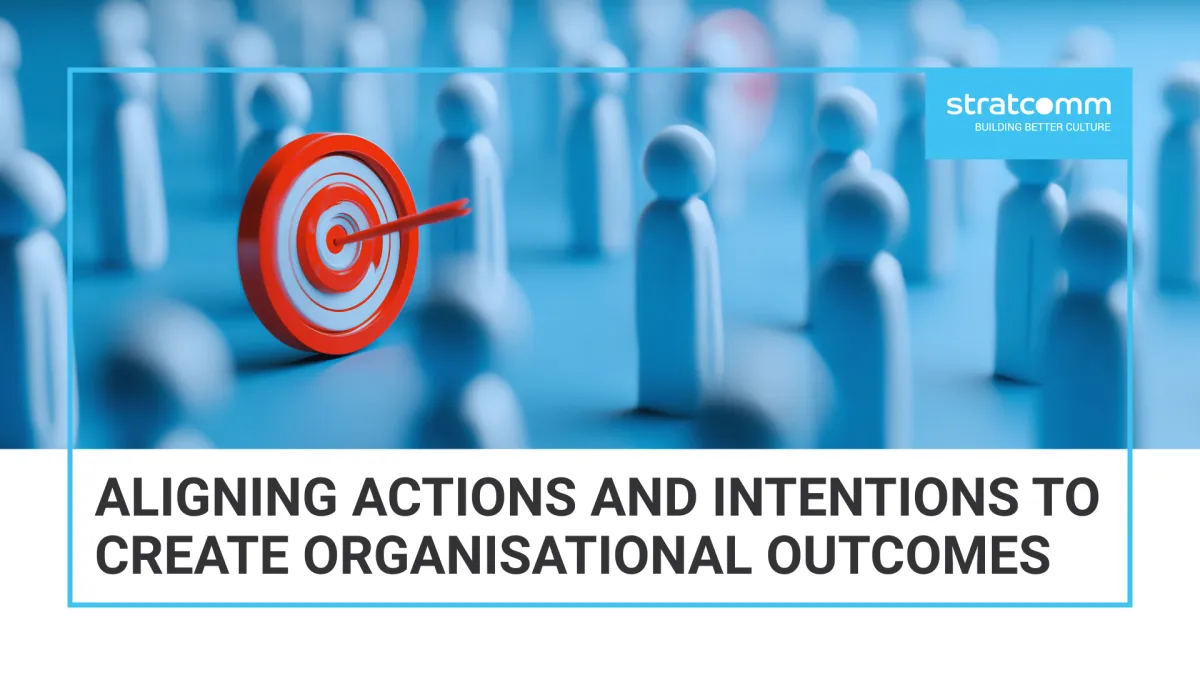
Aligning Actions and Intentions to Create Organisational Outcomes
Most people come to work with good intentions.
Very few people wake up in the morning and consciously decide to gossip, undermine a colleague, withhold information, blame someone else or make the day harder for the people around them. Most people want to contribute well. They want to be respected. They want to do work that matters. They want to be part of something that feels purposeful, productive and worthwhile.
And yet, workplaces are human places. None of us is perfect. We are all capable of thoughts, reactions, assumptions and behaviours that pull us out of alignment with the person we intend to be and the outcomes we say we want.
This is one of the great challenges of organisational culture. There is often a gap between intention and impact.
A person may intend to be honest, but their tone lands as criticism. A leader may intend to create accountability, but their communication creates fear. A team member may intend to protect themselves, but their withdrawal is experienced by others as disengagement or resistance. A group may say they value collaboration, while quietly rewarding individual protection, information control or avoidance of difficult conversations.
Culture is shaped in that gap.
The idea of “above the line” and “below the line” behaviour is one way to help people notice how they are contributing to workplace culture in real time. Above the line behaviours are generally the behaviours organisations want to encourage. They include openness, responsibility, collaboration, respectful communication, trust, curiosity, solution development and a willingness to listen.
Below the line behaviours move in the opposite direction. They often show up as gossip, blame, defensiveness, poor communication, disrespect, bullying, withholding information, undermining others or refusing to take responsibility for one’s own contribution.
The nuance, of course, is that culture is not created by behaviour alone. It is also shaped by attitude, interpretation, energy and intention.
Two people can say the same words and create completely different experiences for the person receiving them. One conversation can feel constructive, while another feels dismissive or loaded. One leader can ask a question that opens reflection, while another can ask the same question in a way that creates anxiety or defensiveness.
It is not only what we say. It is who we are being when we say it.
This matters because people respond not only to words, but to tone, timing, body language, history, trust and the perceived intention behind the interaction. In workplace culture, the message received is often shaped as much by the relationship as by the content.
That is why leaders and teams need to become more conscious of the thinking beneath their actions. Thoughts precede behaviour. Assumptions shape interpretation. Interpretation influences response. Over time, these patterns become culture.
A person who repeatedly thinks, “No one here listens,” may stop contributing. A leader who thinks, “My team is resistant,” may stop seeking input. A team member who thinks, “That person is difficult,” may interpret every interaction through that filter. Once a person is placed into a fixed category, everything they do can become evidence for the story already being told about them.
This is how negativity becomes embedded.
It does not always begin with a dramatic conflict. It can begin with repeated untested assumptions, small acts of judgement, unresolved frustration or conversations that happen about people rather than with them. Over time, those patterns become normal. They influence how people communicate, how decisions are received and whether employees feel safe enough to contribute honestly.
At Stratcomm, we believe that culture is the sum of the behaviours, attitudes, beliefs and interactions that people bring into the organisation every day. It is not separate from individuals. It is created through them. Every person contributes to culture through what they say, what they avoid, what they tolerate, what they challenge and how they respond when things become difficult.
That recognition can be uncomfortable, but it is also empowering.
If we are part of the culture, then we are also part of the opportunity to change it.
The first step is reflection. Reflection is one of the most underused skills in organisational life, yet it is essential for meaningful culture change. Without reflection, people tend to react from frustration, habit or self-protection. With reflection, they can begin to observe their own contribution more honestly and choose a more constructive response.
A simple reflective practice can begin with four questions.
What am I doing?
What am I getting?
What do I really want?
What can I change?
These questions help move a person from judgement to observation. They create space between reaction and response. They invite people to examine whether their current behaviour is aligned with the outcome they actually want.
For example, if a leader wants greater openness from their team but responds defensively whenever concerns are raised, the desired outcome and the lived behaviour are misaligned. If a team wants trust but continues to speak about issues informally rather than addressing them directly, the intention and the action are misaligned. If an organisation says it values feedback but fails to respond meaningfully when employees speak up, the stated value and the employee experience are misaligned.
Alignment requires honesty.
It asks individuals to notice when their thinking has moved below the line. It asks leaders to examine whether their communication builds trust or erodes it. It asks teams to consider whether their habits support the culture they say they want.
This is not about perfection. It is about awareness, responsibility and course correction.
The good news is that people can often return to a more constructive space as soon as they notice they have moved away from their intention. A moment of reflection can shift a conversation. A genuine question can interrupt blame. A willingness to own one’s part can change the direction of a relationship.
This is where Inspired Engagement becomes powerful.
Inspired Engagement is built on the belief that individuals need opportunities to develop insight, take action and expand outcomes. Organisations need to reflect, respond and integrate feedback if they want to create meaningful and sustainable change. The two must work together. Individual awareness without organisational response can become frustration. Organisational intent without individual responsibility can become performance theatre.
True culture change requires both.
Employees need a pathway to contribute honestly and constructively. Leaders need the resilience and discipline to listen, reflect and respond. Organisations need systems that turn insight into action. When those elements come together, culture becomes less about aspiration and more about daily practice.
This also reframes accountability. Accountability is not simply about correcting poor behaviour after it appears. It is about helping people understand the relationship between their thinking, their actions and the outcomes they create. It is about building the capacity to pause, observe and choose a response that aligns with the organisation’s values and purpose.
In a healthy culture, people are not expected to be positive all the time. They are expected to be responsible with their impact. They can raise concerns, name problems, challenge decisions and express frustration, but they do so in a way that remains connected to outcomes rather than blame.
This distinction matters. Observation creates possibility. Judgement often closes it.
When people observe, they can say, “This process is creating delays, and we need to understand why.” When people judge, they say, “No one here knows what they are doing.” When people observe, they can say, “The team is not getting the information early enough to respond well.” When people judge, they say, “Leadership never communicates.” One opens a pathway for action. The other reinforces the existing story.
Organisational culture improves when people learn to communicate from observation, responsibility and shared purpose.
The work begins in ordinary moments. Before a meeting. After a difficult conversation. When a team member frustrates you. When you feel yourself withdrawing. When you notice a familiar story forming in your mind. Those are the moments where alignment is either strengthened or lost.
Ask yourself whether your thinking is above or below the line on the issue in front of you. Ask whether your current behaviour is likely to create the outcome you want. Ask what would change if you approached the situation with curiosity rather than judgement.
The most powerful cultures are not created by good intentions alone. They are created when people repeatedly align their actions with those intentions, even when the work is hard, the conversation is uncomfortable or the pressure is high.
Excellence is not a fixed state. It is a practice.
It is the practice of noticing. Reflecting. Adjusting. Listening. Taking responsibility. Communicating for outcomes. Creating the kind of workplace where people can contribute with honesty, care and purpose.
When individuals align their actions with their intentions, and organisations create pathways for that alignment to become shared practice, culture becomes a source of strength rather than friction.
That is where better organisational outcomes begin.